Pawn Power Lottery Software Review
Reviewed by RivRapp.com

PawnPower is a Windows desktop app that analyzes past US Powerball drawings and then generates or helps you choose lottery numbers based on its own “pattern” and “activity” rules. In plain language: it’s a Powerball number-picking and tracking tool with charts, filters, and automated pick generation.
It also checks your picks against past winning combinations, flags repeats and “unlikely” patterns, and lets you print, save, and review picks more easily.
What It Says It Does
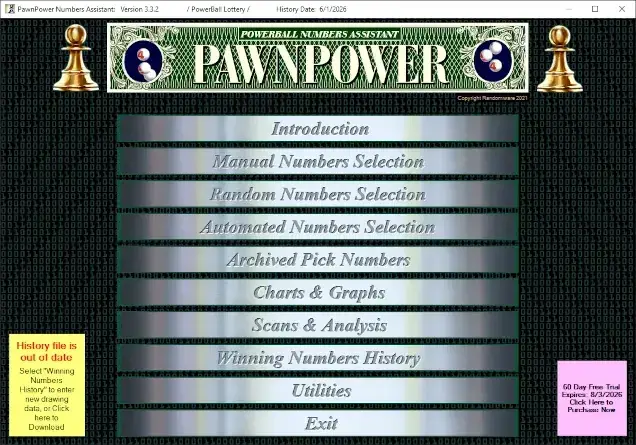
PawnPower presents itself as a Powerball analysis assistant. It loads historical draw data and turns it into charts, lists, and pick suggestions. The software says it can help users decide which numbers to include, which to avoid, and how to build better-looking tickets.
Its core tools are based on a few recurring ideas. It tracks how often each number has appeared. It also tracks how recently each number appeared. It then uses those scores to rank numbers and suggest combinations that fit its rules.
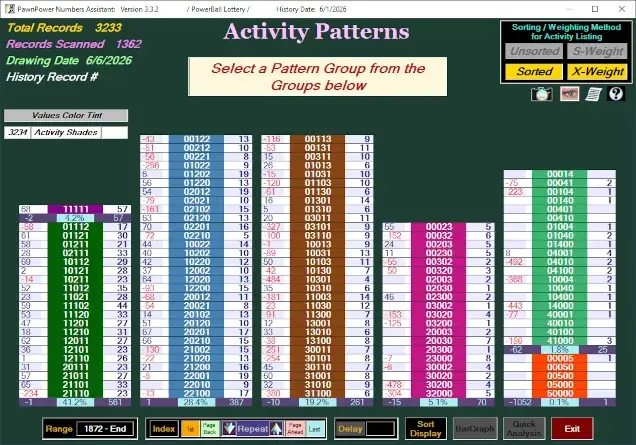
The software also groups draws into pattern types. In simple terms, it looks at how the winning numbers spread across a range and treats some shapes as more common than others. It uses that same approach to build graphs that show the past in different ways. There are bar graphs, line graphs, pattern tables, and other views meant to make the history easier to study.
Another major feature is automatic pick generation. The user can let the program create picks fully on its own, or they can guide the process with pattern choices and other settings. It also checks pick sets against earlier winning combinations and flags obvious repeats.
How It Claims To Work
The sales pitch is built around the idea that random-looking systems still leave useful clues in the data. PawnPower says that past draws contain patterns, biases, and trends that can be observed and used to make smarter choices. It treats numbers that have not appeared recently as 'due', and numbers that have appeared often as less attractive in the short term.
It also leans heavily on visual analysis. The program claims that charts and graphs make hidden tendencies easier to see. The bar graph view is meant to show overall activity. The line graph view is meant to show short-term movement. The pattern tools are meant to reveal which number layouts have happened more often in the past.
There is also a 'pseudo history' feature. That creates fake future-style draw data and runs the same analysis against it. The idea is to test whether the same patterns continue over time. On paper, that sounds analytical. In practice, not so much, it's creating "a set of randomly generated numbers", so different randomness to the draw machine.
What It Does Well
It does organize lottery history, picks, and charts in one place. That part is practical enough. For someone who wants to store tickets, check results, and poke through past draws, it gives everything in a single workflow.
What It Gets Wrong
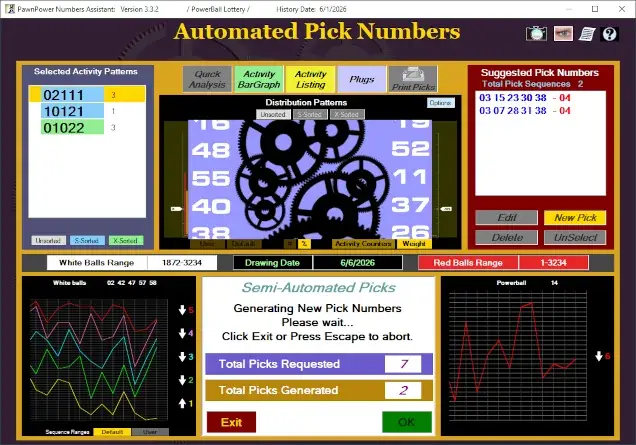
The design is rough. Very rough. The interface feels sooooo dated and cluttered, with loud colours, strange contrasts, decorative textures, and button styles that seem chosen for novelty rather than clarity.
The whole interface has a late-90s shareware-meets-Geocities aesthetic, with loud colours, clashing textures, and almost no visual discipline. I'm trying to look past it but it just keep burning me in the eyes! Just a reminder - this is the latest version of the software (from only 2 years ago).
Their website shares the similar problem.
Where It Becomes Misleading
The software is most solid when it is describing history. It is much weaker when it implies that history can be used to forecast the next draw. It talks about Activity Counters, Activity Patterns, Distribution Patterns, and Piano Roll style repeat checks, but those are all ways of sorting past results, not proof of future edge.
That matters because a pattern can be real and still not be useful. A number can be “hot,” “cold,” or part of a common layout, but that only describes what has already happened. It does not make the next draw more likely to match your ticket.
The same problem applies to its pattern rules. If the software says a certain shape, spread, or repeat structure is common, that may be true as a historical observation. But a common pattern is not the same thing as a winning advantage. At best, it is a filter. It is not a prediction method.
So the misleading part is not that it uses stats. It is that it presents those stats as if they carry predictive weight when the software does not actually prove that they do.
Who Is It For?
PawnPower is probably for lottery players who enjoy digging through past results and want a tool to generate, save, print, and review picks in one place. It is better suited to people who like tinkering with number history than to people looking for a clean, modern, easy-to-use app.
It may appeal to users who enjoy charts, filters, and experimenting with different pick rules. It is a poor fit for anyone expecting polished design, clear visual hierarchy, or a genuinely proven forecasting system. It does also oddly only support the US Powerball!
Conclusion
PawnPower is best understood as an analysis tool wrapped in far stronger claims than its logic really supports. It can organize past draws, score numbers by its own rules, and generate tickets, but it does not show that those rules create any real predictive edge.
That does not make every feature useless. It just means the software is more credible as a way to browse history and manage picks than as a serious method for finding the next winning numbers. It's also pretty darn ugly by any modern software standards, which in itself isn't a nail in the coffin but the bad design does make it far harder to use.