My Review Of The 'Winslips Lottery System' by Stefan Vandervelde

Winslips is the all new and improved version of both the popular 'Inverted Lottery System', and the lesser known 'One-Ticket System'.
But you can't buy either of those products now. Why?
Because this new one is supposed to be better than both of them put together - so let's find out if that's really true.
So What Is It Exactly?
It's basically software to help you pick better lottery numbers. But it promises 3 very important differences:-
- It's NOT complicated
- It doesn't promise miracles, but is simply good at what it does
- It is very cheap to play
So as I review how it works, I'll be specifically looking out for these 3 things -- and holding it up to these promises.
How Do You Use It?
The first thing to point out is that Winslips works entirely in your web browser. That should mean you can run it on pretty much anything these days - including your smartphone. I didn't test it on a phone but the layout is pretty simple so I can't see any reason it wouldn't work on any device with a half decent sized screen.
Here's what the main screen looks like on the inside:
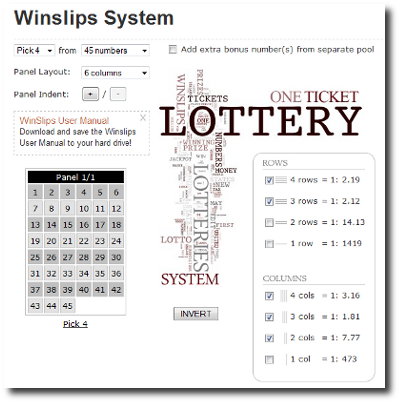
And that really is pretty much all of the software right there. It is actually very simple to use (but there is a really good clear manual that will walk you through the entire process anyway).
All you need to do is set your game type using the drop down menus. So if you're playing a 6 balls from 49 game, you simply choose Pick 6 from the first menu and then 49 numbers from the second. Then you push the 'Invert' button - and that's most of your work done!
So it certainly lives up to promise number 1 so far. This is not complicated!
Don't Miss These Reviews: Win Lotto Systems - Formula 1 Lotto Review - Lotto Guy System - Lotto Looper Review
What the software really does is all hidden behind the scenes and nothing really explains any of what it is actually doing. But when you click the 'magic button' it creates a number of panels - just like you would see on the normal playslip you fill in when you want to buy a lottery ticket. The only difference being, some numbers are missing from each panel. Like this:-
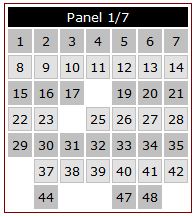
What Stefan has done is take his experience of creating lottery software, and identified what he says are some 'key patterns' for each of the main types of lottery games. It apparently took him over a year of calculations to achieve. But what he's done is come up with a way to reduce the number of combinations you are up against, by using clustering together with exact combinatorial grouping. That is, removing those combinations that he claims are unlikely to be part of a winning cluster of numbers.
In use what this simply means is that each panel is different as each has certain numbers missing. Which ones is the 'secret sauce' of the software of course.
The critical promise (and the supposedly clever math bit) being that despite removing all the bad clusters of numbers -- all the winning numbers are 100% guaranteed to be in one of the panels generated. This is what Stefan refers to as his "100% fail-safe" method. (Note: the number of panels it creates depends on the type of game - but it's normally 4, 5 or 6)
So what does this mean to you?
Well, it means a significant reduction in the number of combinations you're supposed to choose from. Which in theory means a better chance of winning.
The Number Verification Picker
The next step in the process is to generate the actual combinations you are going to play.
And to do this, you simply click once for each panel and a combination is created lke this:-
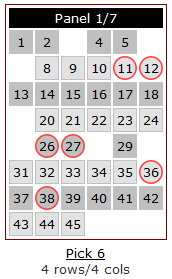
This isn't just a random quick pick though.
What the software is doing here is examining what ithinks the the probabilities of numbers appearing in the same columns and rows are.
So the software automatically works out all the probabilities for numbers falling into 1 row, 2 rows, 3 rows etc. Then does the same again for the columns. Then using only the most 'likely' rules from all of this does it then determine a 'good combination' for you to play.
It would be nice to be given some indication of what methods are being used here. Secret sauce is fine, but we need to know if it this makes any real sense to playing the lottery.
How Many Combinations Do I Have To Play?
You have a choice here. Stefan recommends that you generate 1 combination from each panel - which means you will typically be playing 5 or 6 combinations. But it could be as many as 8 depending on the game.
But if even that is too much for your budget, then Stefan says to simply use 1 panel and play 1 combination. It's obviously not as good as playing 1 from each panel, but it's a whole lot better than nothing!
So at a maximum cost of 8 combinations to play each draw, this certainly meets it's promise of being cheap to play.
What Games Does It Cover?
You can use Winslips for pretty much every Pick 4, 5, 6 and 7 game. And that includes all those games that have extra balls drawn separate to the main numbers - so it works for games like Powerball, Mega Millions and EuroMillions too.
How Much Is It?
The price depends on how long you want access to the software for. Membership starts at $21.95 for 1 month access, but you can also choose 3 months, 6 months and 12 months access which works out a LOT cheaper overall.
NOTE: These are all one-off fees, not subscriptions. You only pay again if you want more access. And don't forget you don't need to change your numbers.
So if you think you will stick to the same game AND the same numbers for the next year, you can just get 1 month access.
Conclusion
The thing I like most about Winslips is that it delivers 100% on it's "easy to use" promise. I've never seen any lottery software this simple to use before. And because you keep playing the same numbers, you only need come back to the software again if you decide to change games, change numbers, or want to create numbers using the latest update of the software.
And it also delivers fully on the promise of being cheap to play. This is even cheaper to play than the Silver Lotto System and that's pretty cheap compared to many systems!
The third promise this system made is that of being "good at what it does". It falls down here though as we don't get any indication as to how Stefan's cluster reduction techniques work. Does the analysis make any sense in the real world of lotteries?
You won't find any gaps in his promise that the winning combination "is in one of the panels created". The problem is though knowing whether there's any better chance of the combinations you end up with from using this being any more likely to win anything. Which isn't a small problem really.